Background to SiteAtlas
SiteAtlas is an independent project exploring photographing, organising and exploring the web.
At its heart is a simple idea: websites change constantly, but most of those changes disappear without leaving any visible record. SiteAtlas periodically takes screenshots of websites and builds a visual history of them, allowing a site to be seen not simply as it exists today, but as it has changed over time.
SiteAtlas was created in the United Kingdom by a private, independent individual. It is not the product of a large technology company, venture-capital project or advertising network. It has been designed, programmed and developed independently over many years.
Website photography
SiteAtlas can perhaps best be described as website photography.
Instead of treating a website merely as a collection of URLs, SiteAtlas records how it actually looked. Screenshots are taken periodically and retained, creating an archive which can show changes in design, branding, ownership, products and the businesses themselves.
A company website may be redesigned several times. A business may change its name, merge with another company or disappear altogether. Products come and go. Logos and branding change. Entire industries alter the way they present themselves.
SiteAtlas provides a visual record of that process.
Where historical screenshots are available, visitors can move through the archived images and see how a website has developed.
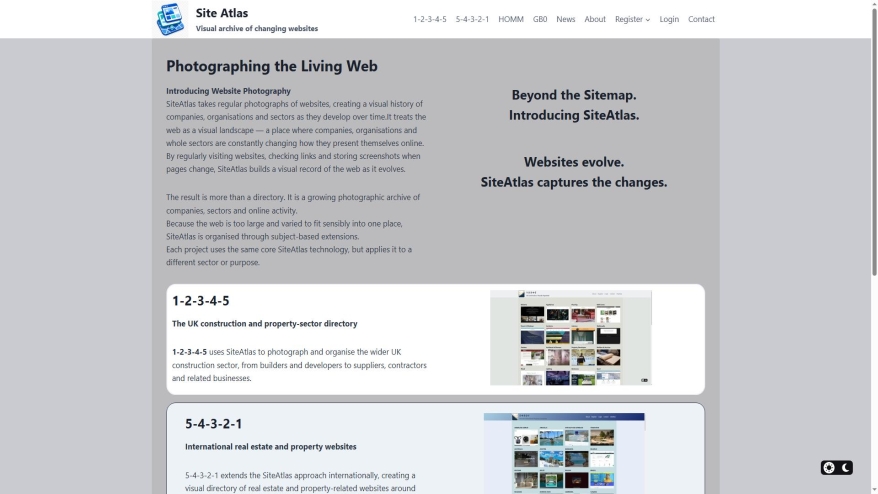
A visual directory of the web
SiteAtlas is also a directory, but deliberately a visual one.
Traditional directories commonly consist of company names followed by rows of text links. SiteAtlas uses screenshots as the principal means of identifying and exploring websites.
A screenshot often communicates far more quickly than a conventional directory description. It gives an immediate impression of the organisation, what it does and how it presents itself.
This makes it possible to browse groups of related websites visually rather than repeatedly opening individual search results.
Categories
Websites within SiteAtlas are organised into subject categories.
These categories form the basis of several specialised SiteAtlas directories, including sectors such as property, construction and general UK businesses and organisations.
Categories can include areas such as:
- estate and property agents
- construction companies
- kitchens, furniture, doors and windows
- accommodation and destinations
- theatres, restaurants and places to visit
- specialist products and services
The intention is not simply to create an enormous undifferentiated collection of links, but to make groups of relevant websites genuinely browsable.
Geographic exploration
Websites can also be explored geographically.
SiteAtlas integrates geographic navigation using places such as towns, counties, areas and countries. Rather than relying exclusively on a conventional search box, a visitor can move into a geographical area and discover relevant websites associated with that place.
This provides another way of looking at the web: not only by subject, but by where organisations operate.
Geographic pages can therefore bring together businesses from many different categories that share a common location.
Search
SiteAtlas includes its own website search facilities.
Searches can be made using company names, keywords and domains, with location information used to narrow results where appropriate.
A search for a product, type of company or specialist term can reveal websites from across the SiteAtlas collection, while a domain search can be used to find a particular website directly.
This search operates alongside the category and geographic systems rather than replacing them. SiteAtlas is intended to support both targeted searching and exploratory browsing.
Historical screenshots
One of the distinguishing features of SiteAtlas is that a website may have more than one screenshot.
A small archive indicator shows when historical versions are available. Moving through those screenshots can reveal years of change to an organisation’s web presence.
In some cases this is simply interesting. In others it provides a useful record of a company’s development.
SiteAtlas has been building this archive since 2010, so some websites have a substantial visual history.
Link checking and maintenance
The screenshot system is also a website monitoring system.
When SiteAtlas revisits a website it is not merely taking another photograph. The process also helps determine whether the domain still exists, whether the website has moved, whether it has changed significantly and whether it should remain within a particular part of the directory.
Websites which disappear can therefore be identified, while active sites can continue to accumulate a visual history.
Much of this process is automated, but the collection is also reviewed and moderated.
Independent moderation
SiteAtlas is not simply an automatically generated search index.
Screenshots and website records can be reviewed, categorised, corrected, refreshed or removed. Sites can be marked for further attention, highlighted as particularly interesting or selected for additional presentation within the directories.
This combination of automation and human moderation is an important part of the project.
Automation makes a collection of this scale possible; human judgement makes it useful.
A family of specialist directories
SiteAtlas is the underlying technology and archive behind a family of related directories.
These include specialist projects concentrating on UK property, construction and building-related businesses, international property and a broader British directory.
Although each site can have its own categories, audience and identity, they can share the underlying SiteAtlas archive.
A single website may therefore be relevant to more than one directory without requiring its screenshot archive to be duplicated.
This allows the project to operate as a network rather than as a collection of unrelated websites.
Website pages
Each recorded domain can have its own SiteAtlas page.
A site page can show the latest screenshot, historical screenshots where available, descriptive information and links to relevant parts of the directory.
This provides a stable SiteAtlas reference for the domain while the website itself continues to change.
Importantly, SiteAtlas does not attempt to replace the website being shown. The screenshot is an introduction and historical record; visitors can continue through to the original website itself.
A different way of finding websites
SiteAtlas is not intended to compete directly with a conventional search engine.
Search engines are extremely effective when somebody already knows approximately what they are looking for.
Directories and visual browsing serve a different purpose.
Sometimes people want to see what is available. They may want to compare companies within an industry, discover businesses in a particular area or simply explore.
SiteAtlas is designed around that form of discovery.
The screenshot is therefore not decoration added to a search result. It is a central part of the navigation system.
Built independently in Britain
SiteAtlas is unusual partly because of the way it has been created.
It is a privately developed British project, created and operated by one independent individual rather than by a large development team.
The screenshot system, database, directory software and much of the supporting technology have been developed specifically for the project.
That independence has allowed SiteAtlas to evolve gradually rather than being designed around advertising, investor requirements or short-term growth targets.
Features have often developed simply because they seemed useful.
The result is a system which has grown organically over many years.
Privacy
SiteAtlas has also deliberately avoided the increasingly common assumption that every visitor must be measured.
The project is not built around advertising profiles or behavioural tracking. Its purpose is to photograph, organise and present websites.
That relatively simple philosophy has remained important as the web around it has become increasingly complex.
An archive that continues to grow
SiteAtlas is not a finished historical archive.
It is a continuing one.
Websites are revisited, new screenshots are created, classifications are refined, domains disappear and new businesses are discovered.
That means the collection represents both history and the present day.
The newest screenshot shows what a website looks like now. Earlier screenshots show how it arrived there.
Together, those images gradually create something that is surprisingly difficult to find elsewhere: a visual record of the ordinary commercial and organisational web.
Large famous websites are extensively documented.
SiteAtlas is particularly interested in everything else.
The builders, estate agents, manufacturers, architects, restaurants, theatres, shops, consultants, destinations, local organisations and thousands of other websites which collectively make up much of the real web.
That is the background to SiteAtlas — an independently built British project attempting to photograph, organise and preserve a small part of an extraordinarily changeable medium.